


Image: Mattias Pettersson
Research group All cells of our bodies have the same genes. Yet only some of them are used in any given cell type. So-called epigenetic mechanisms ensure that genes, which were not selected to be active, remain silent. We employ Drosophila and human cell culture models, genomics, genetics and numerical simulations to understand molecular mechanisms of epigenetic regulation by Polycomb and Trithorax proteins.
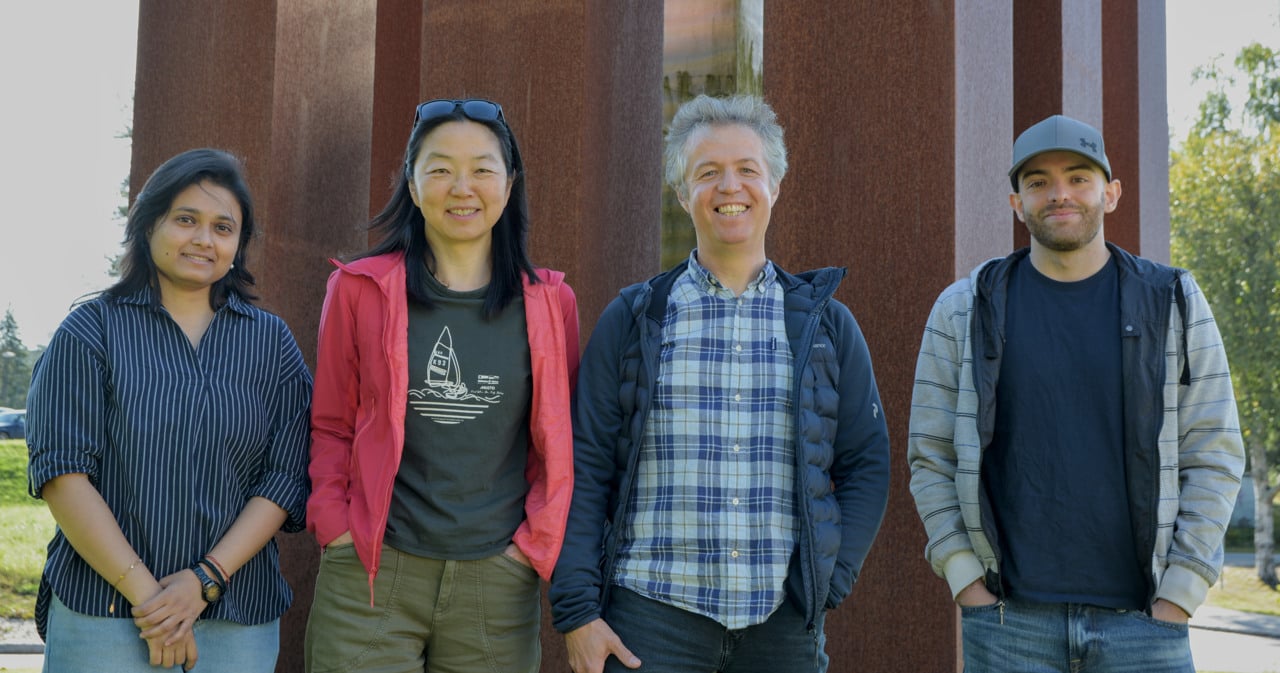
Members of Team Molecular Epigenetics (Yuri Schwartz laboratory).
ImageKarolis Vaitkevicius
Epigenetic repression by the Polycomb system.
The Polycomb system is essential to keep gene expression programs of differentiated cells in check. When the system is damaged, the consequences are often developmental abnormalities and cancer. From years of research by our group and others we learned that the Polycomb system consists of many proteins that act as parts of large complexes PRC1 and PRC2. We know that PRC2 methylates Lysine 27 of histone H3 and that PRC1 recognizes this modification. How this recognition translates into transcriptional repression? What stage of transcription is impaired? How are the two complexes targeted to specific genes? These are some of the challenging open question that we try to answer.
Beyond the histone code: searching for non-histone targets of Trithorax group methylases.
Mutations in genes encoding Trithorax (Trx) and Ash1 proteins cause excessive Polycomb repression, severe developmental abnormalities and, in mammals, have been linked to multiple forms of cancer. In vitro, both Trx and Ash1 can methylate specific Lysines within histone H3. However, histone replacement experiments indicate that methylation of histone H3 is not how Ash1 or Trx stop Polycomb repression. To understand the true mechanism we need to discover other proteins methylated by Ash1 and Trx. We aim to do this by combining biochemical approaches with the power of Drosophila genetics.
Molecular biology of MLL1-driven leukaemia.
Chromosomal rearrangements involving the human Mixed Lineage Leukaemia 1 gene (MLL1 a.k.a. MLL or KMT2A) are found in approximately 10% of acute myeloid leukaemia (AML) in adults, 2%-5% of paediatric acute lymphoblastic leukaemia (ALL), and are predominant (>70%) in infant ALL. Commonly, such rearrangements are balanced translocations that fuse MLL1 with another gene, creating two novel fusion proteins containing N- and C-terminal parts of MLL1. Extensive studies of the last two decades revealed that MLL1 is a histone methyltransferase and that some of its oncogenic fusions are chromatin-associated proteins. However, molecular mechanisms linking MLL1 to oncogenic transformation remain unclear. Does MLL1, like its Drosophila ortholog Trx, act by limiting epigenetic repression of developmental genes? Do oncogenic fusions perturb epigenetic repression of alternative gene expression programs? Is the MLL1 methyltransferase activity critical for its oncogenic function, and what are the relevant substrates? Addressing these questions is another research interest of our laboratory.
Kahn TG, Garrido A, Yushkova A, Kim M, Glotov A, Sreekumar S, Larsson J, Schwartz YB. 2026. Polycomb repression works without Siesta, the Drosophila ortholog of mammalian PCGF3. Science Advances. 12:eaec0733. doi: 10.1126/sciadv.aec0733.
Lundkvist MJ, Lizana L, Schwartz YB. 2023. Forecasting histone methylation by Polycomb complexes with minute-scale precision. Science Advances. 9:eadj8198. doi: 10.1126/sciadv.adj8198.
Barrasa JI, Kahn TG, Lundkvist MJ, Schwartz YB. 2023. DNA elements tether canonical Polycomb Repressive Complex 1 to human genes. Nucleic Acids Res. 51:11613-11633. doi: 10.1093/nar/gkad889.
Lizana L, Nahali N, Schwartz YB. 2023. Polycomb proteins translate histone methylation to chromatin folding. J Biol Chem 299:105080. doi.org/10.1016/j.jbc.2023.105080
Kahn TG, Savitsky M, Kuong C, Jacquier C, Cavalli G, Chang JM, Schwartz YB. 2023. Topological screen identifies hundreds of Cp190- and CTCF-dependent Drosophila chromatin insulator elements. Science Advances 9:eade0090. doi: 10.1126/sciadv.ade0090.
Dorafshan E, Kahn TG, Glotov A, Savitsky M, Walther M, Reuter G, Schwartz YB. 2019. Ash1 counteracts Polycomb repression independent of histone H3 Lysine 36 methylation. EMBO Rep 20: e46762. doi: 10.15252/embr.201846762.
Kahn TG, Dorafshan E, Schultheis D, Zare A, Stenberg P, Reim I, Pirrotta V, Schwartz YB. 2016. Interdependence of PRC1 and PRC2 for recruitment to Polycomb Response Elements. Nucleic Acids Res. 44:10132-10149. doi: 10.1093/nar/gkw701.

In Science Advances, the results are presented that open the door to rewriting a chapter of cell biology.