


Digital Physics
Image: Martin Servin
Image: Martin Servin
Research group With digital physics, you can create virtual replicas of real-world systems. These digital models can be embedded in systems for control, used to produce synthetic training data for AI solutions, and experiment with machines and solutions not yet created.

Researchers combine AI with computational physics in a new project with industry.

The AI system has been developed on a supercomputer in several million training steps.

Algoryx, Infobaleen, Prediktera and Shimmercat are all among the brightest startups within AI in Sweden.
Digital physics is the art and science of creating virtual environments that evolve according to physical laws of motion. This enables safe and controlled experiments with machines and solutions not yet created. Simulation is essential for developing AI-based perception and control that requires large sets of (synthetic) training data.
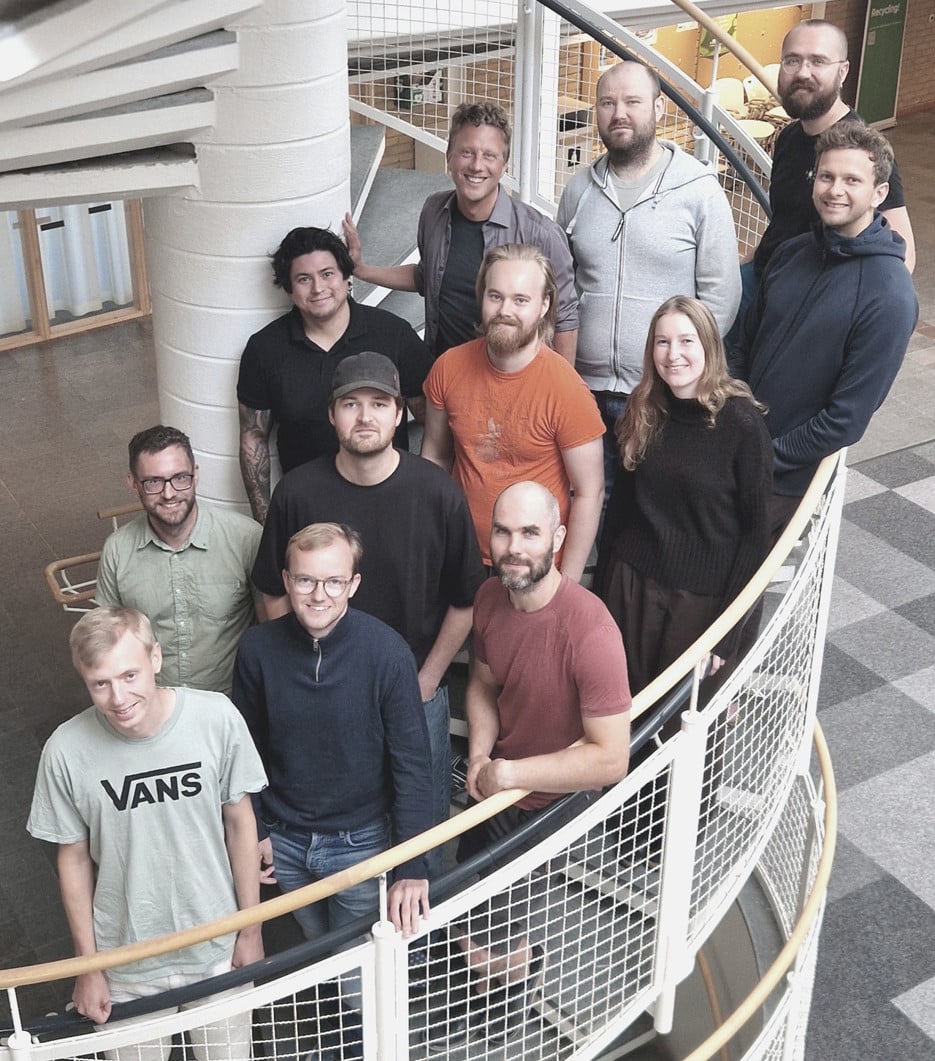
With a mix of different backgrounds, the group tackles various problems in digital physics.
Image Björn TorkelssonThe research group is devoted to the underlying computational science - how to achieve rich, faithful & fast digital physics. We also explore new ways of using digital physics that go beyond traditional use of simulation, e.g., for developing machine perception and intelligence for systems operating in dynamic and unstructured environments.
We specialise in discrete variational mechanics, multibody and multiphysical systems with non-smooth dynamics, discrete elements, and the tailoring of high-performance numerical methods and reduced-order modelling for fast simulation - often in realtime. Our active research include also deep integration of physics models and numerical solvers with artificial intelligence.
We have a special interest in modeling and simulation of granular material, soil, heavy equipment, robots, material handling and processing systems found in construction, forestry and mining.
For more information and a list of publications, see our own website digitalphysics.se.

The Artemis project aims to establish a permanent base on the Moon using lunar soil and regolith. The design and control of the construction machines needed for this task are still under research. The project focuses on developing key simulation and AI solutions to support this development.

Heavy mobile machinery are designed to physically manipulate their surroundings. In XSCAVE, we combine computational physics with artificial intelligence (AI) to create safe and efficient systems for autonomous control.

A research program focused on digital tools and automation technology, utilizing the large data in the forest sector, for the societal transition towards a sustainable circular bioeconomy.

In this research project, a physics-informed digital twin of a rock breaker is developed and made autonomous using deep learning.

Computational tools tailored for forestry science and technology.

The Collaborative Robotics Lab is a shared research infrastructure for novel research in a wide range of robotics.